CURRENT FLOW IN A CIRCUIT
A current of electricity is a steady flow of electrons. When electrons move from one place to another, round a circuit, they carry electrical energy from place to place like marching ants carrying leaves. Instead of carrying leaves, electrons carry a tiny amount of electric charge.
Electricity can travel through something when its structure allows electrons to move through it easily. Metals like copper have “free” electrons that are not bound tightly to their parent atoms. These electrons flow freely throughout the structure of copper and this is what enables an electric current to flow. In rubber, the electrons are more tightly bound. There are no “free” electrons and, as a result, electricity does not really flow through rubber at all. Conductors that let electricity flow freely are said to have a high conductance and a low resistance; insulators that do not allow electricity to flow are the opposite: they have a low conductance and a high resistance.
Electric Circuit
The electric circuits are closed-loop or paths, forming a network of electrical components where electrons can flow. This path is made using electrical wires and is powered by a source, like a battery. The start of the point from where the electrons start flowing is called the source, whereas the point where electrons leave the electrical circuit is called the return. Let’s conduct a small experiment; you would need the following,
- Electric bulb
- Wire
- Electrical tape
- A battery
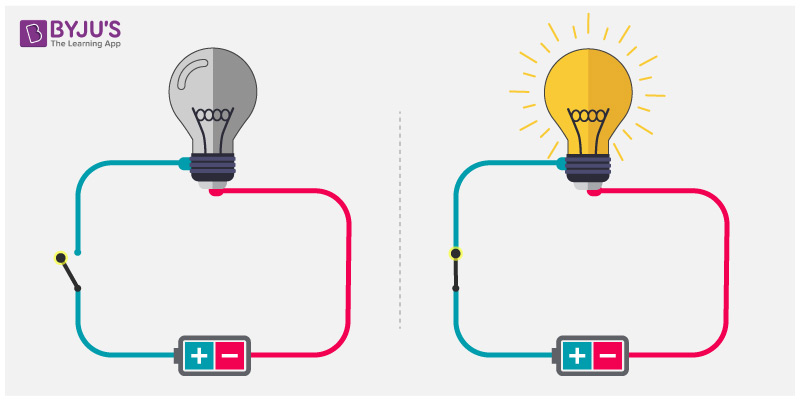
Connect the wires to the bulb and connect one end of the wire to the battery. Notice what happens, there won’t be any change in the bulb, but when you connect the free wire to the battery and complete the circuit, you will notice that the bulb starts glowing. Therefore the circuit must be completed for the current to flow.
An electrical circuit is complete only when there is at least one closed loop from the positive to the negative end. This is the simplest form of an electric circuit. The circuit found inside a television is more complicated and has different components.
How the torch bulb glows...Prepare an arrangement to light a bulb using two torch cells, one torch bulb and two pieces copper wires.Light the bulb. This arrangement is an electric circuit.Observe the diagram of the circuit. A path is prepared for current to flow from one terminal to the other terminal of the torch cells through a copper wire and a bulb .The bulb glows when the circuit is complete. Such a circuit is called a closed circuit.


Comments
Post a Comment